


W A Johnson, BSE Chem Eng, University of Michigan, United States
Corresponding author, Email: wajohnson@rockwellautomation.com
J G Walker, BS Computer Science, University of Oklahoma, United States
Corresponding author, Email: johnnywalker@thorsolutions.us
S Schiavella, BSE Mechanical Eng, Politecnico di Milano, Italy
Corresponding author, Email: sschiav@rockwellautomation.com
Synopsis
Recent years have shown an increasing trend in overall delay days necessary to finish a ship’s maintenance availability due to unexpected and unplanned work growth involved to accomplish the tasks defined for the ship’s Class Maintenance Plan during that availability. The planned machinery equipment maintenance activities in the Main Machinery and Auxiliary Machinery Rooms required far greater effort and scope than originally planned. To get ahead of that problem, ship maintenance planners are looking for greater situational information of these machinery systems to more accurately develop maintenance plans and work tasks before the ship enters the repair yard. One system of interest is the ship’s service diesel generators and identifying the degradation of engine parts prior to their failure by using the operational data to identify the symptoms of failure types and translating those symptoms into appropriate work breakdown tasks for the maintenance plan. This paper delves into a method of deploying a Support Vector Machine (SVM) machine learning model at-the-edge in the ship’s machinery room to collect that engineering data and transform it into failure symptoms useful to ensure replacement parts, tools, and hardware scope are sufficient to the maintenance to be performed.
Keywords: Edge Analytics; Support Vector Machine, Electrical Generators; OCI Containerization; AI/ML Diagnostics
1. Introduction: Greater situational awareness for Maintenance Planning
With shipboard operations undergoing a transformative evolution toward digitalization, sustainability, and enhanced security, control system architectures are evolving to achieve these innovations as well. Modern shipboard power and propulsion systems are a focus for this transformation. This paper will describe their operational enhancements enabled by both software platform analytics through an AI machine learning model and embedded edge computing architectures with interoperability capabilities from Kubernetes and Dockers containerization technology that improves situational awareness, early fault detection, and decision-making for shipboard generators. On-prem and SaaS software platforms integrate real-time telemetry data from the ship’s onboard sensors such as electrical output, engine load, fuel consumption, temperatures, vibration, and rotational speed into a single data-lake of information located at the edge for live monitoring, historical review, and advanced analytics such as predictive maintenance, autonomous navigation, and energy optimization. Coupled with advanced AI models, dynamic performance baselines under varying operating conditions can be established. Patterned deviations from baseline indicate emerging problems for identification, prioritization and creation of consequent actionable recommendations for operators. This capability enables earlier intervention before casualty cascade, more informed operational and maintenance decisions, and improved reliability and readiness. Second, modular control system designs at-the-edge driven by software app containerization technology support the highest sustainment of these smart ship functionalities through facilitating interoperability across diverse hardware and software platforms. AI agent software applications and their host computing platform designs at-the-edge lead to intelligent, secure, and optimized maintenance planning. This synergy anticipates future technological advancements too, ensuring machine learning control systems remain resilient and adaptable in an evolving maritime landscape.
Authors’ Biography
Stefano Schiavella, Global Product Manager for Rockwell Automation. He received a Bachelor of Science degree in Mechanical Engineering with specialization in Automation and Robotics at the Politecnico of Milan. He has 20+ years of industrial automation experience, with technical, sales, industry management and product management background. He is currently managing Compute and Edge within Logix Controllers portfolio, including communication protocols such as OPC UA, MQTT.
Warren Johnson is the Marine Industry Manager for Rockwell Automation. He received a Bachelor of Science degree in Chemical Engineering from the University of Michigan. Mr. Johnson served as a naval officer in the U.S. Navy then transitioned to a career in controls engineering. He has automation systems design, development, and integration experience of over 25 years across various industries including marine and power generation. He has worked in industrial control and automation solutions from Rockwell Automation for a significant portion of that time.
Johnny Walker, CEO/ President of Thor Solutions LLC, is a retired U.S. Navy officer. Afloat, CAPT Walker commanded USS CHAMPION (MCM 4) and USS GUNSTON HALL (LSD 44). Ashore, CAPT Walker served as a Navy Staff, OPNAV N85/95 Requirements Officer / Resource Sponsor, PEO Ships LCAC & SSC (LCAC 100 Class Craft) Acquisition Program Manager—and as the PEO Ships MAAC Ships Program Manager, (PMS 470). He is a University of Oklahoma computer science graduate & completed an MMAS in Middle Eastern Studies at the U.S. Army CGSC.
2. Cybersecurity via Rootless Enhanced Security
Efforts to enhance the situational awareness of approaching failures during operations of an electric power plant’s generators necessitate advanced analytics at-the-edge to transform the generators’ anomalous events into predictive machine learning analysis. Any computer at-the-edge presents security vulnerabilities (e.g. DISA’s CVEs and CWEs), which are threat vectors to the ship’s propulsion and main machinery systems; thus, a unique approach is a computing surface with rootless enhanced security. Running a Service in a Windows OS or a Daemon-based Process within Linux means access to the computer’s utilities or kernel of persistent functional tasks that include network port management, network port access, security login and access control, computer system resources and database usage, memory storage and memory utilization and other functional operating system services. All such utilities functional usage requires administrator privileges to direct, orchestrate, control, and release those computer resources. Traditional deployment of a software platform on a computer server meant exposing privilege access to the computer server’s utilities and resources so that the applications hosted within that platform have the resources necessary to accomplish their functions and performance features. This means access to administrator level privileges and places a risk on the hosting environment of unauthorized control and disruption of background tasks essential to the operating system or management interface images. When such resources are exposed for use by hosted applications, an application user may gain the access rights to administrator privileges due to necessity of an apps function. One of the top Ten cybersecurity threats is malware and viruses attacks through unauthorized access to administrator privileges (Red Canary, 2026). This kind of cyberattack from utilizing privilege escalation through gaining higher-level access from low-level accounts has seen a dramatic increase. On a global scale, weekly cyberattacks hit an average of 1,968 per organization in 2026, marking a 70% hike since 2023. Credential theft for privilege abuse has grown by 71% year-over-year, often resulting in full environmental control (SentinelOne, 2026). The most effective approach to defeating that threat vector is eliminating the need for elevated privileges entirely for application usage and performance. That is possible through a growing industry adoption of implementing non-administrative privilege based applications which have access only to their “namespace” on their container or image hosted Linux Distribution. Operational access of the Kernel or Services is quarantined off because these containers are without root privileges or “rootless”. An example of that method is a rootless Linux Yocto Distribution where the access to any application is strictly driven by namespace control of services and no further. The latest computer surfaces at the edge of manufacturing floors or operational assets must employ this methodology to derive the greatest adoption across use-cases. This adoption also applies for shipboard hull, mechanical, and electrical systems and installation across those systems within a ship’s main machinery room, auxiliary machinery room, propulsion system, and electrical power plant distributed electrical system.
3. MTP Standard (Module Type Package)
The Module Type Package (MTP) is a standard initially defined by NAMUR Recommendation NE 148, in collaboration with organizations such as ZVEI, to enable modular automation in the process industries.
NAMUR is the international user association for automation technology in the process industries, representing plant owners and operators rather than automation vendors. With more than 150 member companies worldwide, NAMUR brings a strong operator-centric perspective focused on lifecycle efficiency, interoperability, and long-term asset sustainability. [controleng.com], [namur.net]
A core motivation behind MTP is the need for plug‑and‑produce modularity—the ability to design, integrate, operate, replace, and upgrade functional units (skids or modules) quickly and predictably. NAMUR members have extensive experience operating complex plants composed of equipment from multiple suppliers and understand that sustainable plant operation depends on standardized interfaces, standardized data models, and standardized operator interaction.
Principle and Purpose
MTP defines a vendor‑neutral, standardized description of an automated process module (also referred to as a skid or package unit), allowing it to be rapidly integrated into a higher‑level automation or orchestration system without custom engineering. Rather than being a communication protocol itself, MTP specifies how a module exposes its capabilities, data, and interaction model in a consistent way.
The standard has evolved into an IEC-recognized framework for modular plant lifecycle management, promoting a design philosophy where facilities are composed of self‑contained, semi‑autonomous modules. Each module can be independently commissioned, operated, maintained, upgraded, or replaced, reducing engineering effort and operational risk over long service lifetimes—a key requirement for shipboard power and propulsion plants.
MTP Scope and Content
An MTP formally describes an automated module, including:
- Services – the functional capabilities provided by the module (e.g., start, stop, regulate, diagnose)
- State model – standardized operational states and transitions
- Interfaces – communication endpoints, typically based on OPC UA
- HMI visualization – uniformly defined operator faceplates and views
- Alarms and parameters – semantics, priorities, and limits associated with module operation
This information ensures that a module from one supplier can be integrated and operated consistently alongside modules from other suppliers, using a common orchestration and visualization environment.
Data Format and Engineering Integration
An MTP is typically delivered as an AutomationML (AML) file, an internationally standardized, XML‑based data format as defined by IEC 62714.
AutomationML is specifically designed for the exchange of automation engineering information across heterogeneous tools and disciplines, making it well suited to represent modular automation assets over their entire lifecycle.
The AML‑based MTP file can be imported into a Process Orchestration Layer (POL), such as a DCS, PLC‑based orchestration system, or industrial edge orchestration platform. This import operation automatically establishes:
- Communication connections
- Data tags and services
- Alarm definitions
- Operator visualization artifacts
- This capability dramatically reduces manual engineering, eliminates error‑prone point‑to‑point integration, and accelerates commissioning.
Key MTP Architectural Concepts
The MTP standard introduces several key architectural concepts.
- Process Equipment Assembly (PEA)
An automated, safety‑considered, and largely autonomous modular process unit. A PEA may consist of one or more functional assemblies and represents a discrete processing function or infrastructure service within a modular plant.
- Process Orchestration Layer (POL)
A higher‑level automation and information layer responsible for coordinating, supervising, and optimizing multiple PEAs. The POL spans traditional automation and IT domains and provides centralized operation, visualization, and data access.
- Module Type Package (MTP)
The formal, machine‑readable description of a PEA’s automation interfaces, functions, data, and visualization, serving as the contract between the PEA and the POL.
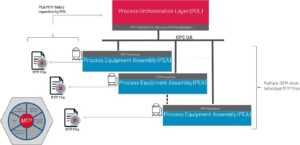
Figure #1
Relevance to Shipboard Power and Propulsion Plants
In the context of shipboard power and propulsion systems, MTP principles directly support edge‑enabled operational data transformation by:
- Promoting modular, replaceable power and propulsion subsystems
- Enabling standardized data exposure at the edge for optimization and analytics
- Reducing integration effort across multi‑vendor equipment landscapes
- Supporting long‑term lifecycle sustainability through modular upgrades rather than system‑wide refits
At the core of this approach, the MTP file supplied by the equipment or skid vendor represents the definitive interface between a shipboard subsystem (PEA) and the supervisory orchestration or edge control layer (POL). It contains all the information required for secure monitoring, control, and optimization—enabling smarter, more adaptable, and more sustainable shipboard operations.
4. Software Portability and Lifecycle Management Benefits at the Edge
Achieving smart, optimized, and sustainable performance in shipboard power and propulsion plants requires an edge computing architecture that is resilient, secure, and adaptable over long operational lifecycles. Software portability and lifecycle efficiency are therefore critical design principles. These goals are effectively addressed through the adoption of container-based software architectures.
Containerization streamlines software development, deployment, portability, and lifecycle management by decoupling applications from the underlying hardware and operating system. Applications are packaged together with their dependencies into self-contained units, ensuring consistent execution across development, testing, and operational environments. This approach significantly reduces integration complexity and mitigates the risk of software drift over time, which is particularly important in maritime environments characterized by long asset lifecycles and limited maintenance windows.
At the foundation of this approach is the Open Container Initiative (OCI), a set of open, industry-wide standards that define how containers are built, packaged, distributed, and executed in a portable and interoperable manner. By adhering to OCI standards, containerized applications can be deployed consistently across different edge platforms and suppliers, avoiding vendor lock-in and enabling long-term software reuse across multiple vessels and system generations.
Container technology also provides strong isolation between applications and the host operating system. Each container runs in its own isolated execution environment with explicitly controlled access to hardware resources and operating system services. This isolation model improves system robustness and increases cyber resilience by preventing faults, misconfigurations, or vulnerabilities in one application from propagating to other workloads or to the underlying platform.
When containerization is combined with a hardened, locked-down operating system—one that does not expose a traditional desktop environment, shell access (SSH), or command-line interfaces (CLI) to end users—the result is a secure and controlled edge computing surface. In this model, users interact only with approved applications and services, not with the operating system itself. This significantly reduces the attack surface, enforces operational discipline, and aligns with defense-in-depth cybersecurity strategies increasingly required in critical maritime and naval applications.
This architectural pattern has become a common and proven approach across the latest generation of edge-enabled devices, including solutions such as the Embedded Edge Compute module, Optix Edge, and the LogixEdge™ Controller. These platforms are designed to execute containerized workloads close to shipboard power and propulsion assets, enabling real-time data processing, analytics, and optimization directly at the edge—without reliance on continuous connectivity to centralized or cloud-based systems.
In addition, by adopting industry-standard container engines such as Docker and lightweight Kubernetes distributions like K3s, and by exposing their management APIs in a controlled manner, these edge platforms enable the use of standard IT and DevOps deployment pipelines. This allows operators, system integrators, and OEMs to leverage familiar enterprise tools for application deployment, versioning, rollback, and lifecycle management, while maintaining strict control over the operational environment.
Security is integral to this approach. Access to container engine APIs is protected using strong authentication and encryption mechanisms, including mutual Transport Layer Security (TLS) certificate exchange. This ensures that only trusted users, systems, and automated deployment tools can interact with the edge platform to deploy, update, or manage containerized applications. As a result, software updates and functional enhancements can be delivered safely and repeatably throughout the vessel’s operational life, supporting continuous improvement in performance, efficiency, and sustainability without compromising system integrity or availability.
5. Machine Learning AI Model for Ship’s Electrical Power Plant Generators
The culmination of the above IoT and cybersecurity principles enables use of secure, high-available computational edge devices in the machinery spaces of a vessel that will effectively capture the specific time-series operational data, periodic events, and anomalies that enhance the ship’s crew situational awareness, decision making, and early fault detection for their vessel’s electrical generators and similar engines. Earlier studies by others have been accomplished to deploy condition-based maintenance plus (CbM+) analysis on machinery systems to predictively detect failures with the goal to increase availability and overall reliability of the ship’s electrical plant. Similar to the KPI framework of the whitepaper from Spandonidis, Iliopoulos, and Athanasopoulos, a framework could be developed for the performance of a diesel generator, or other internal combustion generator, and applied to develop a baseline of operational data and Machine Learning AI model useful to accurately assess the root causes leading to a generator’s performance deterioration. An example of a naval ship’s electrical power plant in Figure #2 shows the makeup of the redundant design for starboard and port generation and bus tie breakers. Diesel generator #1, DG1, and diesel generator #2, DG2, within this electrical system are the example components intended to gain the benefits of predictively determining root cause failures by establishing this baseline of operational data and deriving a Machine Learning AI model.

Figure #2 Ship’s Electrical Power Plant
The machine learning AI model is derived from a comparison of the deviation between measured versus expected values for a single key performance indicator (KPI) of power output, kW, per unit of fuel oil consumed in one hour, kg/h, for the generator and a correlation to that generator operating sensors’ measured values. This KPI deviation is calculated from Equation (1).
Dev = ((Pwr/Fuel Consumed)m – (Pwr/Fuel Consumed)e)/(Pwr/Fuel Consumed)m x 100% (1)
Where Pwr/Fuel Consumedm is measured performance of Power produced per fuel consumed and Pwr/Fuel Consumede is expected performance of Power produced per fuel consumed. Measured parameters that will be tracked along with this KPI include power fluctuation, inlet and outlet exhaust temperatures, oil pressure, coolant flowrate, crankcase pressure, compression ratio, vibration, voltage, current, frequency, overload changes, alternator winding temperature, and RPM. These parameters can be used to establish the generator’s set of dynamic operational baselines under various operating conditions with which to then correlate patterns of deviations from the KPI leading to predictive failure analysis. In 2025, another study (Yanling Liu, Yanzhuo Wu 2025) applied a Support Vector Machine SVM machine learning algorithm as one of three algorithms for inputs into a Bayesian optimized XGBoost model for failure prediction. Rather than applying that complex methodology, a reduced order model of the SVM machine learning algorithm could be deployed within a PLC edge device at the generator in the machinery room. This corollary from that paper’s model could be applied in a reduced overhead manner for computational processing constraints and encapsulated into an OCI container in that aforementioned PLC edge device.
Non-Linear Support Vector Machine SVM Methodology
The methodology of the non-linear SVM algorithm can be used for multi-class failure type predictions such as overheating, lubrication loss, injector fault, and others. Those measured parameters stated in the section above are captured by the PLC and iteratively transferred via an interface connection to an edge computational device in that same PLC chassis and those sensor values are transformed into engineered calculations of RMS vibration, temperature rate-of-change, oil pressure variance, load fluctuation index, and Exhaust Gas Temperature imbalance. When the base KPI’s deviation is above an adjustable threshold from measured to expected values, these engineering calculations can be recorded and stored in the edge device for over a 6 – 12 month period to establish trending of these engineered values. The SVM algorithm then scales those engineered values either by standard scaler for vibration and temperature and MinMax Scaler for pressure and electrical load values. The model’s next step is applying a Radius Basis Function (RBF) kernel to the scaled data sets and then a Bayesian optimization to tune the model.
SVM Concepts
The working idea behind a traditional linear SVM is to separate the data into two classes by maximizing the margin of separation between the two classes and defining the best boundary between the data which is the hyperplane (L2). The larger the margin above and below that hyperplane, the better the model performs on new data. The distance from the hyperplane to the nearest data points in each class is the support vector respectively for that data class (L1) for the blue data and (L3) for the red data shown in Figure 3.
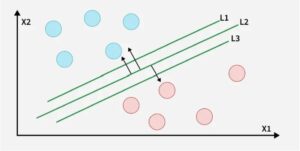
Figure #3 for Linear SVM Representation
SVM can have a soft margin which allows for some misclassifications of the boundary margin to improve generalization. This is accomplished by the equation of Figure #4 to balance the maximization of margin and minimize the penalty.

Figure #4
The penalty is referred to the hinge loss which has the following characteristics: if the data point lies outside the margin and is correctly classified, the penalty is zero; if the data point is correctly classified, but lies within the margin that is between L1 and L2 or L3 and L2, or is misclassified, the penalty is greater than 0; if the data point is incorrectly classified or traverses the margin, the penalty proportionally increases to the distance of the traverse.
Non-Linear SVM
When the data is non-linear, as is the case with diesel generator failure types, these concepts are taken forward into the non-linear SVM algorithm following a technique using a kernel to plot the data into a 3D dimensional space to appropriately separate and classify the data into greater subgroups. The kernel method most appropriate for the data classification of diesel generators is called Radial Basis Function (RBF) Kernel. Since the data collected of the generator’s engineered calculations captured at discrete moments when the KPI deviation is outside the threshold will not be linearly separable, i.e. non-linear, the RBF Kernel will accomplish a dot product of those engineered calculations to transform them into a 3D dimensional space whereby they are separable into various classifications of failure types. In that higher dimensional space, the SVM model then determines the linear boundaries that separate the data points into associated root-causes of failure types.

Figure #5
The root causes based on the data set of engineered calculations can be separated into these classifications: cooling system failure, lubrication low, injector or fuel pump failure, electrical overload and harmonics, air intake restrictions, exhaust system backpressure, governor failure.
6. Conclusions
Use of non-linear SVM machine learning AI models can be deployed on ship at the edge in the machinery rooms to capture the data points during anomalous behavior of the ship’s generators to develop a classification system of root cause failure types. This model identifies the failure predictively for the crew, giving them greater situational awareness of their generators condition before a failure occurs. Simplify this non-linear SVM model deployment’s data collection by constraining it on collecting data only when the deviation threshold is met between measured and expected KPI values of power produced, KW, per fuel consumed in an hour, kg/h, as that anomalous event. This reduces the size of the data set to a reduce order model for implementation within an OCI container python or other program application within a PLC’s chassis computational device. The shipboard sustainment requirements for this SVM model deployment are reduced through the “plug and produce” principle of the MTP Standard for standardized interfaces and behaviors of hardware and there are long-term portability and security benefits for the software application program from hosting it within an OCI Container inside a rootless Linux distribution.
Acknowledgements
The views expressed in this paper are those of the authors and do not necessarily represent the views and opinions of Rockwell Automation or Thor Solutions.
References
Red Canary – a Zscaler company, (2026, February). “Executive Summary: 2026 Threat Detection Report” https://redcanary.com/resources/lp/threat-detection-report-executive-summary/?utm_source=google&utm_medium=paidsearch&utm_campaign=Threat-Detection&gad_source=1&gad_campaignid=6519348620&gclid=EAIaIQobChMIpa6xt-X6kwMVhkn_AR3bcRhpEAAYAiAAEgJqIPD_BwE
SentinelOne, (2026, March 12th). “Key Cyber Security Statistics for 2026” https://www.sentinelone.com/cybersecurity-101/cybersecurity/cyber-security-statistics/
Walker, Andy and Jal Desai. 2023. Battery Energy Storage System Evaluation Method. Washington, DC: U.S. Department of Energy Federal Energy Management Program. DOE/GO-102023-6083. https://www.nrel.gov/docs/fy24osti/87546.pdf.
Spandonidis, Christos, Vasileios Iliopoulos and Iason Athanasopoulos. (2025, July 28th). “Machine Learning-Powered KPI Framework for Real-Time, Sustainable Ship Performance Management” Journal of Marine Science and Engineering (JMSE) 13(8):1440
Liu, Yanling and Yanzhuo We (2025 April 23rd) “Bayesian Optimization of XGBoost Model for Machine Failure Prediction and Model Interpretability Analysis” 2025 5th Asia-Pacific Conference on Communications Technology and Computer Science.
Article “Support Vector Machine (SVM) Algorithm” (2026, May 2nd) https://www.geeksforgeeks.org/machine-learning/support-vector-machine-algorithm/


